Order 21
Leads and
Secondaries
The book flips here. Nineteen orders taught you to take bases away. The last ten teach you to steal them back — starting with the first few feet.
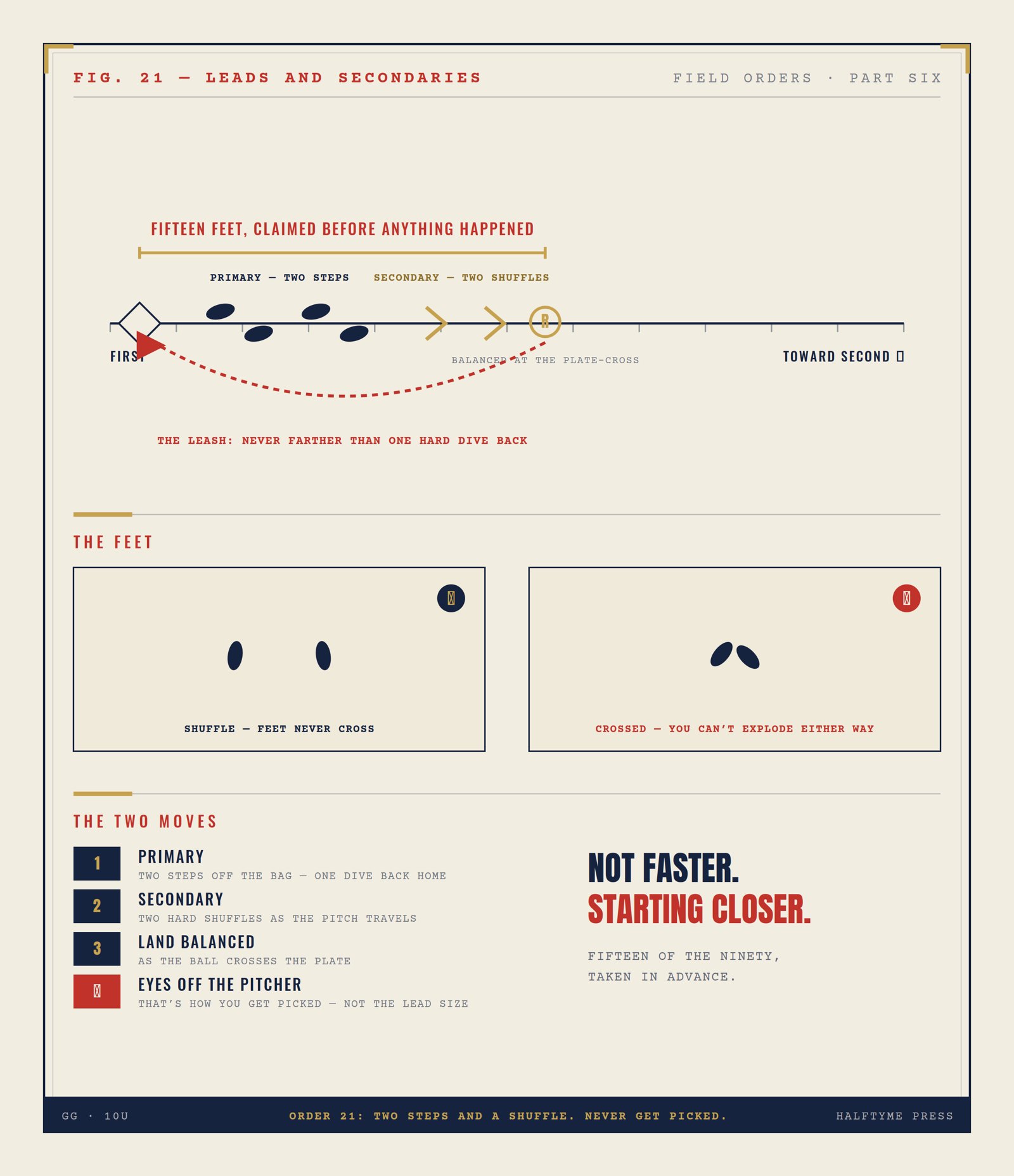
The primary lead is what you take before the pitch: two confident steps off the bag, maybe a bit more, with one rule governing all of it — never farther than one hard dive back. Your lead is exactly as big as your ability to return. Bigger than that isn't aggressive, it's a gift to their pitcher.
The secondary is what you take as the pitch travels: two hard shuffles toward the next base, landing balanced as the ball crosses the plate. The shuffle is the whole trick — feet moving sideways, never crossed, so you can explode either direction. Ball's hit? You're already moving. Ball's caught? You're balanced to get back. Ball's in the dirt? You're closer than anyone who stood still.
Watch what this adds up to: the lead plus the secondary is fifteen feet of the ninety, taken before anything has even happened. Good baserunners aren't faster. They start closer.
The Two Moves
Four Reps — Write It In
What decides how big your primary lead gets? Write the rule as a distance you can feel, not a number of feet.
Why do we shuffle the secondary instead of just walking or leaning toward second?
Pitch crosses the plate, catcher gloves it clean, and you're at the peak of your secondary. What's your very next move?
Ball skips off the catcher's glove and rolls six feet away. Who reaches the next base — the runner who took his secondary or the one glued to the bag — and how much of that race was over before the pitch bounced?
The Trap
Getting picked off doesn't usually happen because the lead was too big. It happens because the runner's mind left first — he was watching the batter, dreaming about second, feet crossed mid-shuffle. The pickoff doesn't beat your legs. It beats your attention. Keep your eyes on the pitcher until the ball leaves his hand, every time, and the lead takes care of itself.
I judge baserunners the same way I judge fielders in Order 09 — by what they're doing when nothing has happened yet. Anyone can run after contact. The secondary is effort spent on a pitch that's probably a called strike, forty times a game, and that's exactly why it wins: the one time the ball squirts loose, you already paid for the base three shuffles ago.
Two steps and a shuffle.
Never get picked.
Order 22
Reading the
Ball Down
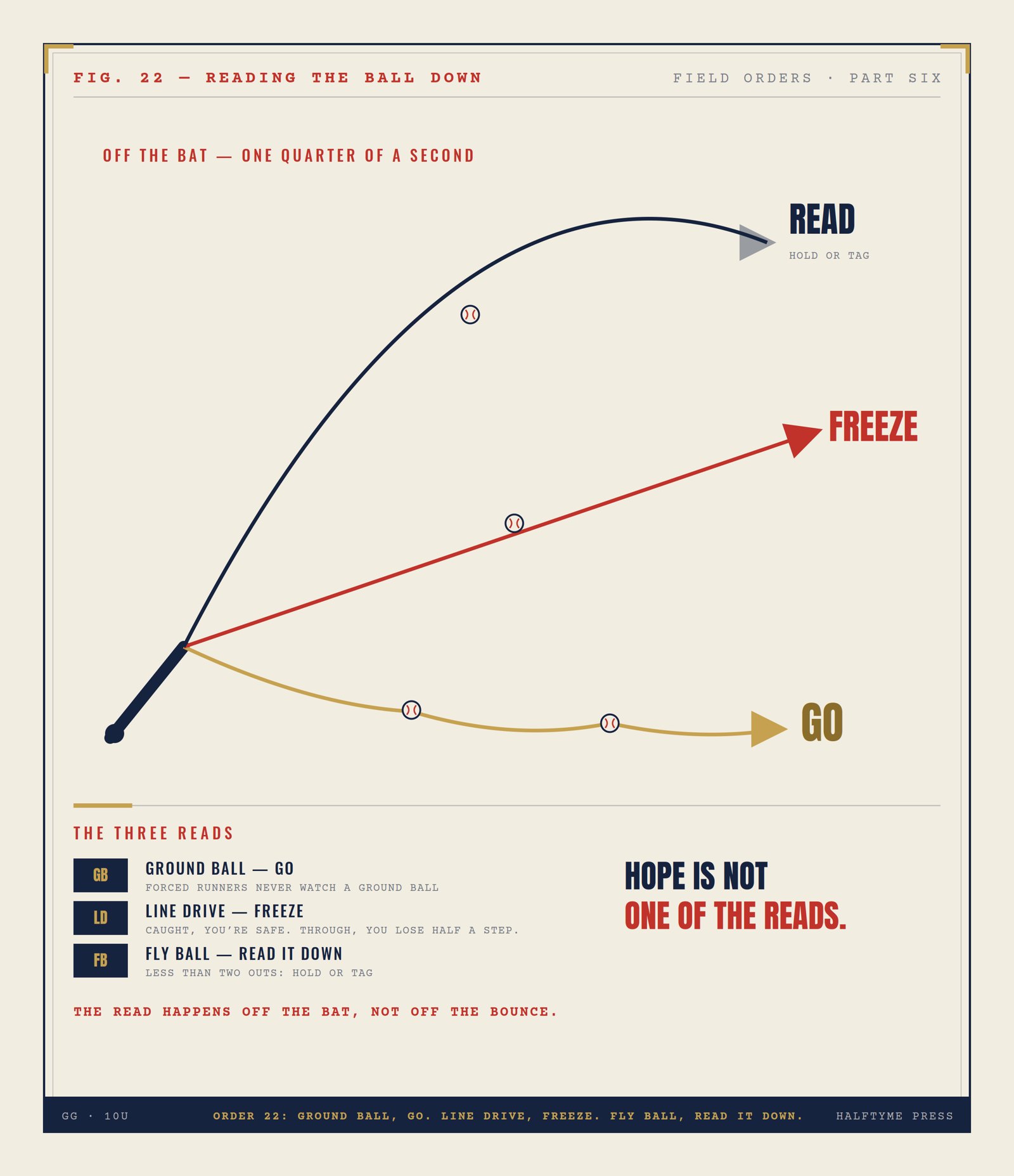
Contact happens, and you have a quarter of a second to answer one question: what kind of ball is that? Three kinds. Three answers. Memorize all three and the quarter-second is enough.
Ground ball: go. If you're forced — and Order 04 taught you when you are — there's no decision left; you're running the moment it touches dirt. Not forced? Then go only if it's behind you or through, but a forced runner never watches a ground ball.
Line drive: freeze. This is the hard one, because a line drive looks like the best hit in baseball and your legs want to celebrate. Freeze anyway. A caught liner with you halfway to the next base is the fastest double play that exists — the fielder barely has to try. Freeze, read caught-or-through, then go. You lose half a step on the ones that get through. You save an entire out on the ones that don't.
Fly ball: read it down. Less than two outs, you hold or you tag — that's the next order. The short version here: a fly ball is a question, and you don't run on a question.
The Three Reads
Four Reps — Write It In
You're on first, nobody out. Sharp ground ball to short. Are you deciding anything right now?
You're on second, not forced. Screaming line drive right at the shortstop. What do your legs do, and what would it cost if they did the other thing?
Same liner — but it's past the shortstop's glove and into the outfield. When did you start running, and why is being half a step late here okay?
Write the three reads from memory, one word each — then say them out loud with your eyes closed. This is the one you'll use most this season.
The Trap
The line-drive freeze feels like cowardice the first fifty times you do it. The ball is smoked, your dugout is up yelling, and you're standing still like you missed the play. You didn't miss it — you read it. The runner doubled off on a liner ran on hope. Hope is not one of the three reads.
This is Order 03 wearing a helmet. The read is fast only if the plan already exists — "liner, I freeze" decided before the pitch is a reflex; decided after contact is a gamble. Baserunning IQ isn't reacting quickly. It's having nothing left to react to.
Ground ball, go. Line drive, freeze.
Fly ball, read it down.
Order 23
Tagging
Up
A deep fly ball with less than two outs isn't an out waiting to happen. It's a delivery service — if you're standing in the right place when it arrives.
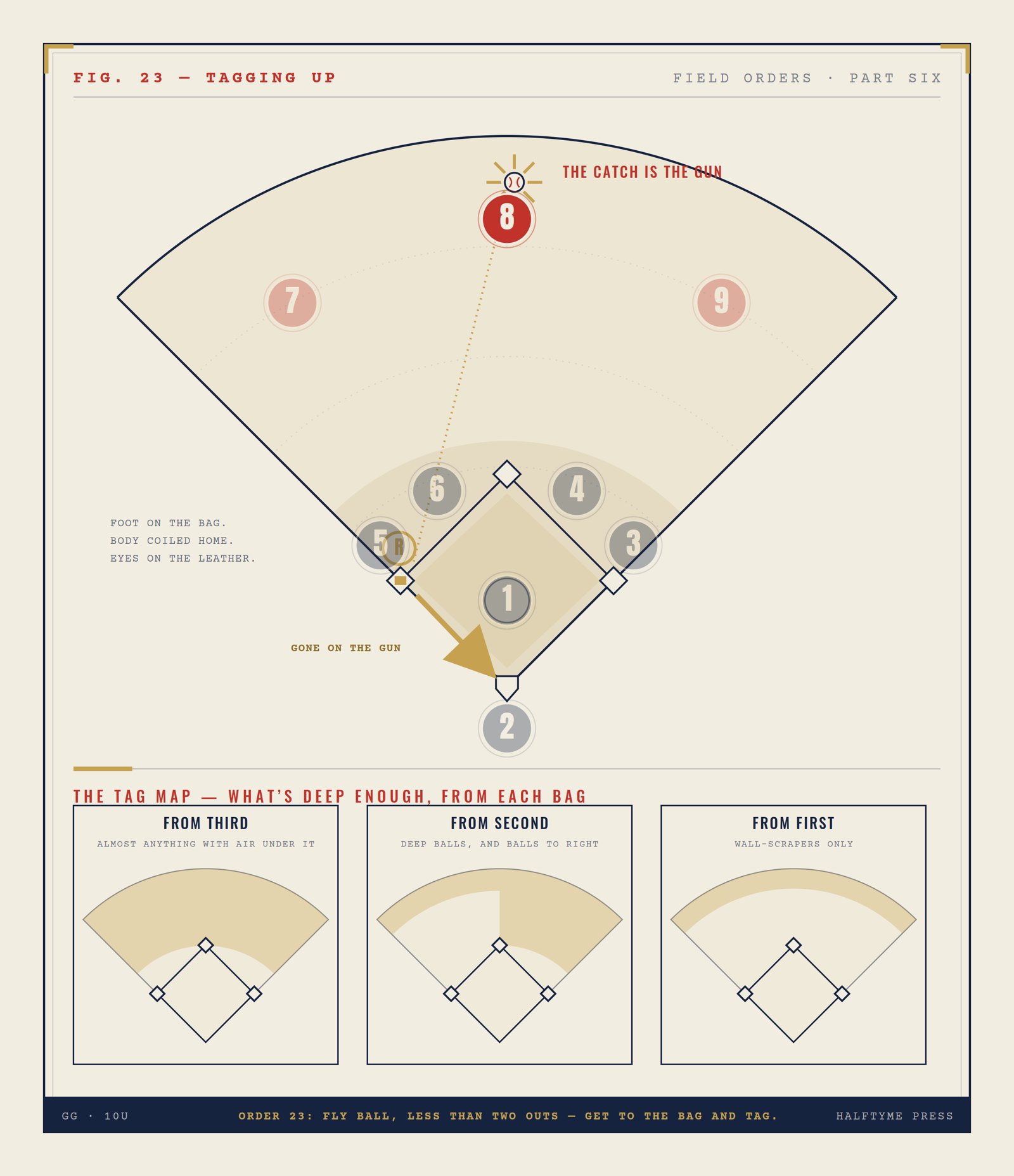
The rule of the tag: you may advance on a caught fly ball, but only if you're touching your bag at the moment of the catch. So the play is simple. Ball goes up, deep enough to matter — get back, foot on the bag, body coiled toward the next base, and watch the ball into the glove. The catch is your starting gun. Glove touches leather, you're gone.
When does deep enough matter? From third, almost any medium fly scores you — this is where runs come from, and it's why Order 22 told you a fly ball is a question. From second, you tag on balls hit deep or to right, because the throw to third is long. From first, you tag rarely — only on a ball at the wall.
The shallow fly is the judgment call: too short to tag, too dangerous to drift. On those, get back, touch, and hold — a free base you didn't take is still yours. An out you handed them is gone forever.
The Tag Map
Four Reps — Write It In
You're on third, one out, deep fly to center. Where is your foot, where are your eyes, and what starts your sprint?
You're on second, one out, medium fly ball to right field. Tag-worthy or not — and what makes right field different from left here?
You drifted halfway to home on a fly ball instead of tagging. It's caught. Describe the next four seconds of your life.
Shallow pop fly, you're on third, infield fly territory. Why is get-back-and-hold the winning play even though nobody advances?
The Trap
Drifting is the disease. Halfway feels smart — you're closer if it drops! — but halfway is the one place on the baseline where both outcomes beat you: caught, and you can't get back; dropped, and you've lost the head start a tag would've banked from the bag. The bag is where all your options live. Drift, and you own none of them.
The tag from third is the closest thing baseball has to a free run, and it's powered entirely by patience — a kid willing to go backward first so he can go forward faster. Plenty of runs in our season will score without a hit, because someone coiled on a bag, watched leather, and left on the gun. That run belongs to the reader of this page.
Fly ball, less than two outs —
get to the bag and tag.
Order 24
Two Outs
Changes It All
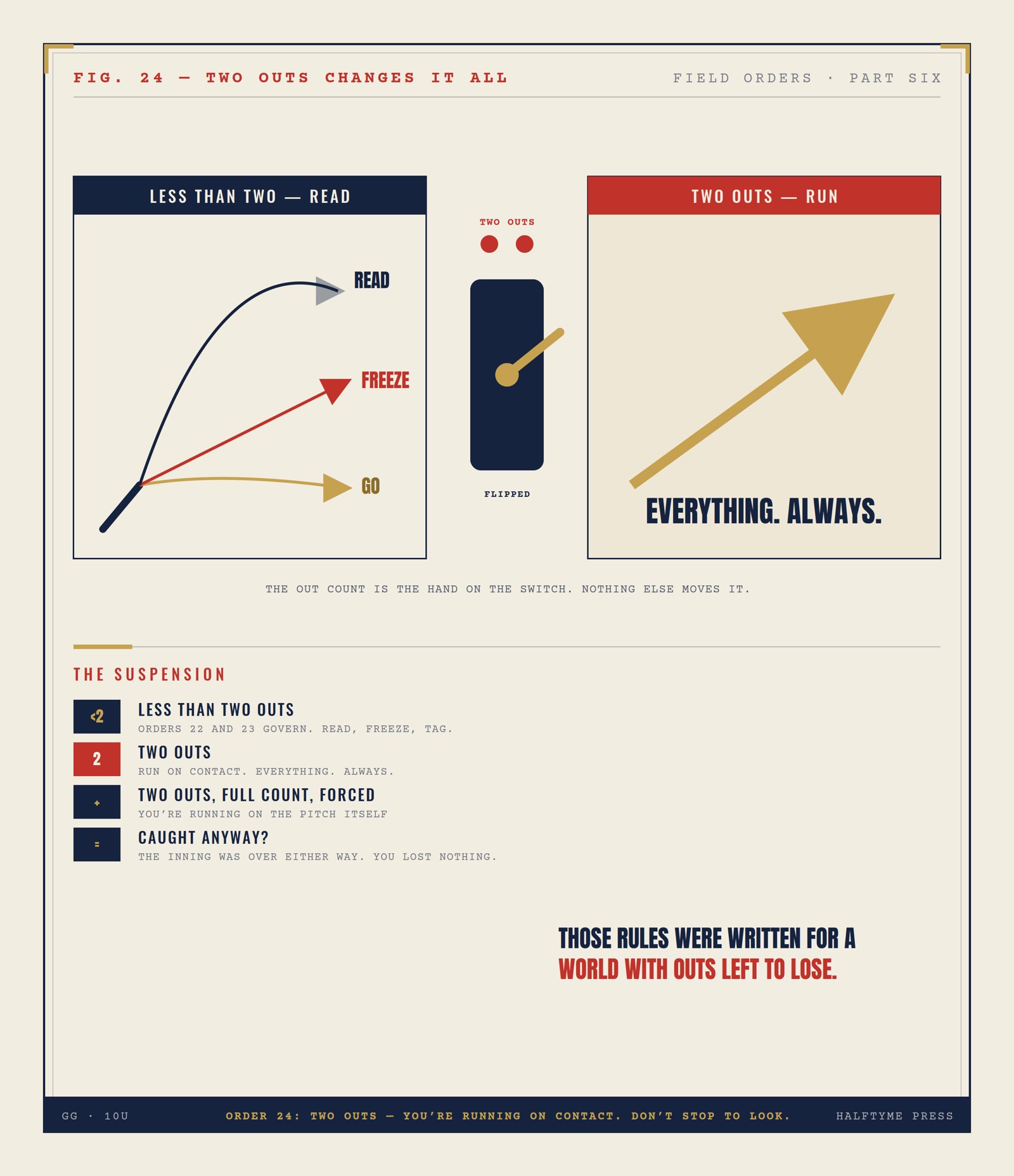
Stop. Before this page, the book taught you to freeze on liners and tag on flies. This page repeals both. Two outs, and the rules you just memorized are suspended.
Here's the logic, and it's clean: every rule in Orders 22 and 23 exists to protect you from the double play and the double-off. With two outs, there is nothing left to protect. If the ball is caught — liner, fly, anything — the inning is over whether you're standing on your bag or standing in the dugout. Being doubled off costs nothing that the catch didn't already take.
So with two outs you run on contact. All contact. Ground ball, gone. Line drive, gone. Fly ball, gone — no tag, no read, no looking back. The only version of the future where the inning continues is the one where the ball hits the ground, and in that future, you want to be two bases into your sprint, not one.
This is the easiest order in the book to understand and the hardest to obey, because Orders 22 and 23 will be screaming at you from two pages ago. Let them scream. They were written for a world with outs left to lose.
The Suspension
Four Reps — Write It In
Two outs, you're on second. Screaming liner right at the shortstop. Order 22 said freeze. What do you actually do, and why is 22 wrong here?
Two outs, you're on third, high fly ball to left. Do you tag?
Two outs, full count, you're on first. Explain why you're running on the pitch itself — before contact even happens.
One out — not two — and your teammate takes off on a fly ball like it's two outs. What did he forget, and what does it cost?
The Trap
The trap runs both directions, and rep D is the proof. Freezing at two outs wastes the free sprint. Sprinting at one out is the double-off Order 23 warned you about. The skill was never "run" or "freeze" — it's knowing the out count so cold that your legs pick the right rulebook without asking your brain. Order 02 said take the count before every pitch. This page is why.
Watch our third-base coach with two outs — arm windmilling before contact, yelling "you're running on anything!" That's not a strategy, it's a reminder, because he knows your instincts are two pages behind. The best two-out baserunners are a little bit reckless on purpose. It's the only time in baseball I'll ask you to stop thinking.
Two outs — you're running on
contact. Don't stop to look.
Order 25
Taking the
Extra Base
Singles become doubles in the first three steps past first base — not at second. By the time you can see whether the extra base is there, it's too late to start wanting it.
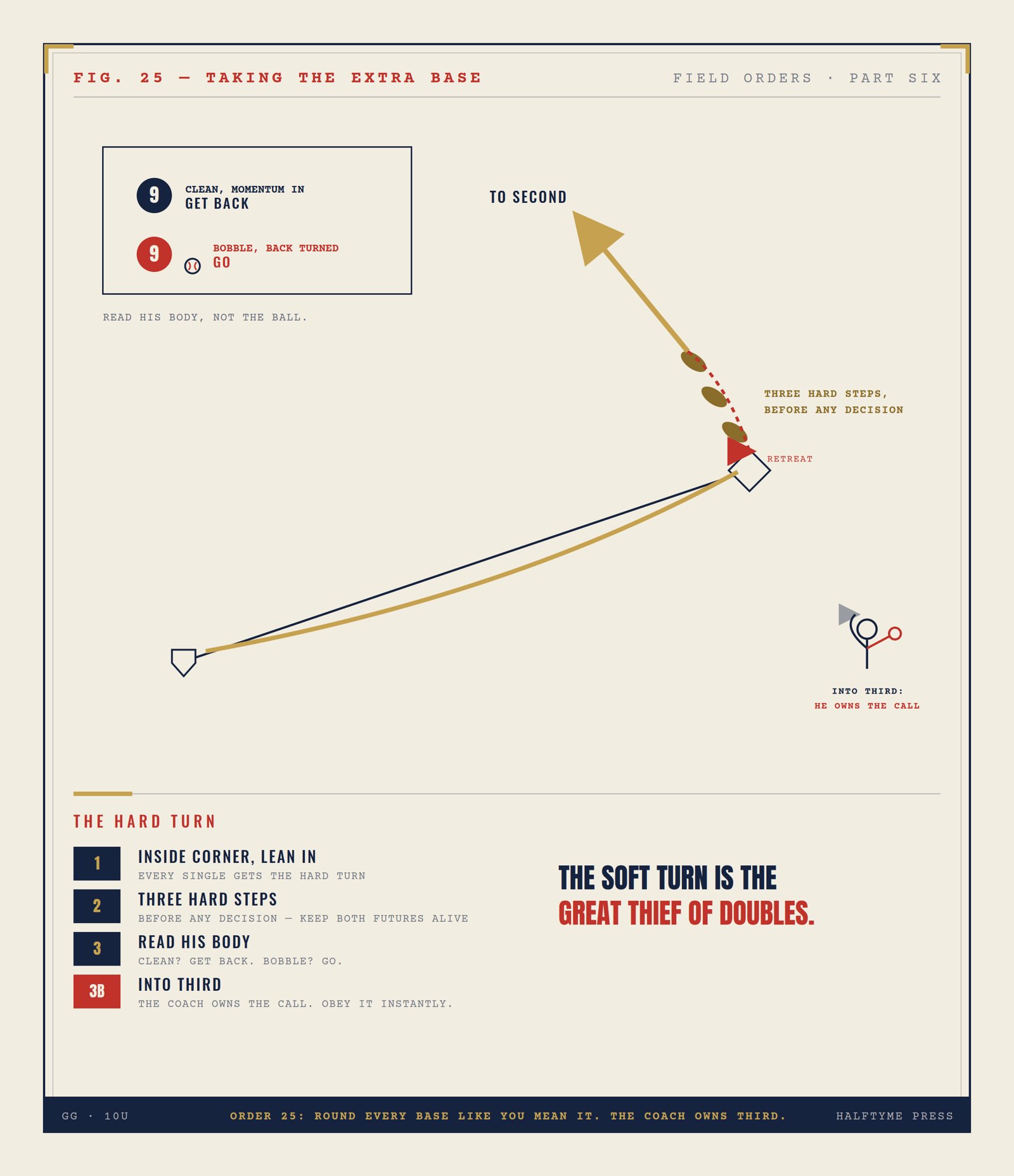
So the rule: round every base like you mean it. Every single gets the hard turn — hit the inside corner of the bag, lean in, and take three aggressive steps toward second before you decide anything. The turn costs nothing. If the outfielder fields it clean, you retreat, and all you spent was effort. If he bobbles it, takes a lazy route, or lobs the throw in — you're already a third of the way there, and the base is yours because you rounded before you knew.
What you're reading in those three steps is his body, not the ball. Fielding clean, momentum toward the infield? Get back. Ball kicked, back turned, jogging? Go. His body announces the play before his throw does.
And the boundary: from home to second, your eyes make the call. Heading into third, the coach owns the decision — the play is behind you now, and he can see what you can't. Round hard, then obey the windmill or the stop sign. Both, instantly.
The Hard Turn
Four Reps — Write It In
Clean single to left, fielded on the second hop. Do you still make the hard turn — and what did it cost you?
Single to right, and the right fielder takes it casually, gloves it jogging, lobs toward the infield. Which of his three body signals told you to go?
You're flying around second, ball somewhere behind you in right-center, and the third-base coach throws up the stop sign — but you're SURE you can make it. What do you do, and why is sure not enough?
Why do the three hard steps come BEFORE the read instead of after it? What's gone if you watch first and turn second?
The Trap
The banana turn — the wide, gentle loop that feels fast because you never slowed down — is the great thief of doubles. A runner who rounds soft has already voted: he voted for staying at first, before he saw a single thing the outfielder did. The hard turn isn't a decision to go. It's a refusal to decide early. Keep both futures alive for three more steps.
Rep C is the last lesson of the defensive book hiding in the offensive one — it's Order 14 again. You're the cutoff man now: the play is behind you, the coach can see it, and obeying the man with the better view IS the smart play, even when your legs disagree. Aggressive feet, obedient eyes. That's a General on the bases, and that's the whole part in four words.
Round every base like you mean it.
The coach owns third.