Order 26
Winning
the Count
Every at-bat is really two contests. There's the pitch you can see — and underneath it, a running score called the count, quietly deciding who's in charge.
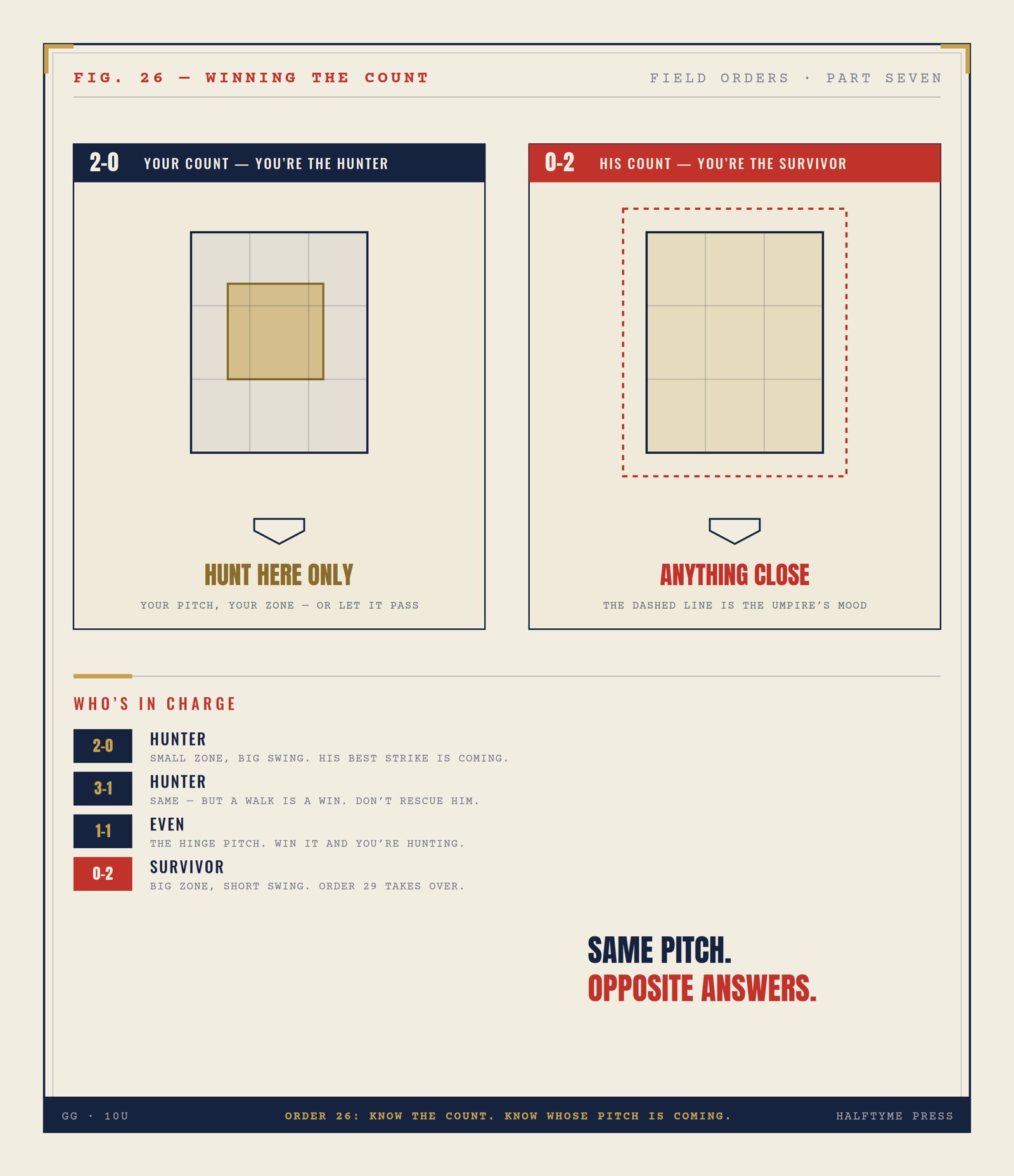
Ahead in the count — 1-0, 2-0, 2-1, 3-1 — the pitcher has to come to you. He can't afford another ball, so something hittable is coming, and that means you're allowed to be picky. This is when you hunt your pitch: the one in your happy zone, the one you drive in practice. See anything else, even a strike? Let it go. A strike you didn't want is a small price for the swing you did.
Behind in the count — 0-1, 1-2, 0-2 — the deal flips. Now he's allowed to be picky, painting corners, wasting one in the dirt to see if you'll chase. Your zone has to grow. Anything close, you're swinging — not to do damage, but to survive to a better pitch.
Same batter, same pitcher, same swing. The count decides which one of you is hunting and which one is protecting. It's Order 02 with a bat in your hands: the fifth fact was always the one that moves.
Who's In Charge
Four Reps — Write It In
Count is 2-0. A strike comes in, but it's low and away — not your pitch. Swing or take, and what does taking cost you?
Now it's 1-2. Same exact pitch, low and away, catchable but ugly. What changed?
Draw your happy zone in words — where's the pitch you drive best? Be honest, not hopeful. This answer becomes your 2-0 hunting ground all season.
It's 3-1. What pitch is almost certainly coming, and why does the count force his hand?
The Trap
Reps A and B are the same pitch with opposite right answers — the book's oldest trick, played one last time. If that feels familiar, it should: it's Order 02's ground ball, Order 12's lead runner, Order 24's line drive. The situation, not the ball, decides the play. Hitters who swing at 2-0 like it's 1-2 aren't aggressive. They're just not keeping score.
I don't need you to be a great hitter this season. Ten-year-old swings come and go with growth spurts. I need you to be a great count-keeper, because that skill compounds forever. The kid who knows when he's in charge of the at-bat will out-hit the kid with the prettier swing by the time they're both fourteen. Every year, without fail.
Ahead in the count, hunt your pitch.
Behind, protect the plate.
Order 27
Runner on 2nd,
Nobody Out
This is the at-bat where doing your job looks like doing nothing. You will ground out to the right side, jog back to the dugout — and you will have won.
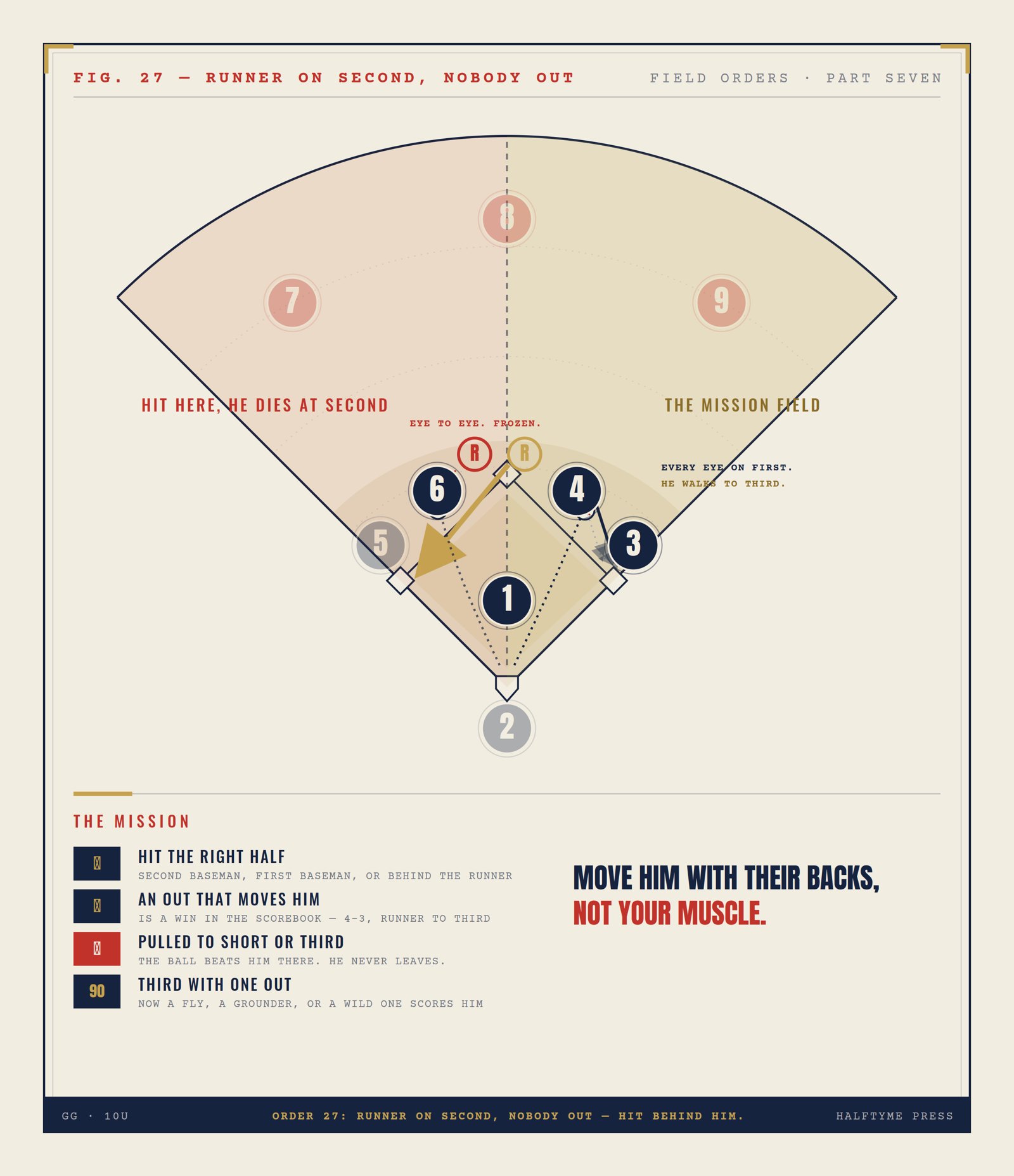
Here's the arithmetic. A runner on second with nobody out scores on almost anything once he reaches third — a groundout, a medium fly (Order 23 taught him the tag), a wild pitch, an error. A runner stuck on second needs a real hit. So the mission of this at-bat isn't a hit: it's ninety feet. Move him to third, and you've turned three chances to score into a near-certainty.
How: hit the ball to the right side. A ground ball to the second baseman or behind the runner means the play is at first — the whole infield's back is turned to him, and he walks into third. Pull one to shortstop or third instead, and he's frozen, staring at the fielder, going nowhere.
The scorebook will call it an out. Your on-base percentage will frown. And the next batter drives in a run that you built. Some of the most important at-bats of our season will end with you jogging back to the dugout — and me meeting you at the top step.
The Mission
Four Reps — Write It In
Why is a runner on third with one out worth more than a runner on second with nobody out? List two ways he scores from third without a hit.
Why does a ground ball to the RIGHT side move him and a ground ball to the LEFT side freeze him? It's about where the fielders are looking.
You're the runner on second now, not the batter. Grounder to short — right at the shortstop's glove, in front of you. Go or hold? Which earlier order already answered this?
You ground out to second and the runner takes third. The scorebook writes 4-3. Write what actually happened.
The Trap
Nobody bats .1000 on this play — even trying to hit the right side, you'll pull some. That's baseball, not failure. The trap is never trying: swinging for the fences with a job on the bases, because the fences get the cheers. A General who won't trade his at-bat for the team's run isn't a slugger. He's a soloist, and soloists lose to orchestras in October.
Watch what I do, not what the scorebook does. When you give yourself up on purpose and it works, I will meet you at the top step of the dugout like you hit one off the fence — because to me, you did. The stat sheet measures what you got. I measure what you gave. Those are different numbers, and only one of them wins championships.
Runner on second, nobody out —
move him over.
Order 28
Runner on 3rd,
Less Than Two
Order 27 built this moment: runner on third, less than two outs, run standing ninety feet away. Now finish it — and finishing it means aiming low.
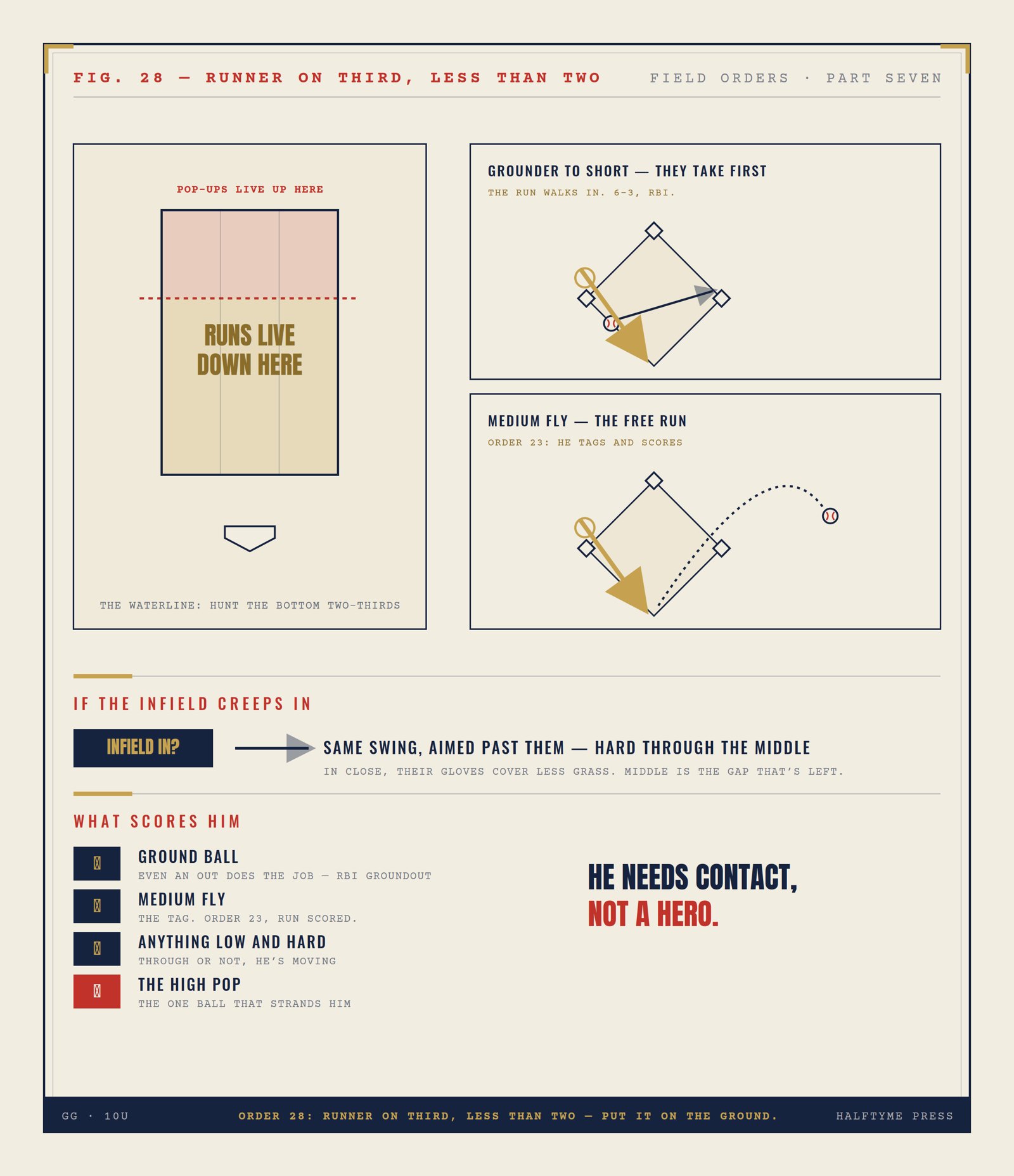
Count what scores him. A ground ball with the infield back — he walks home while they take the out at first. A medium fly ball — Order 23's tag, the free run. A ball up the middle, an error, a wild pitch. Now count what doesn't: a strikeout, and a pop-up. That's the whole list of failures, and both of them live at the top of the strike zone, where big swings chase high pitches.
So the mission is contact, and the target is on the ground or up the middle. Not a bomb — a transfer. Shorten up a touch, look for something you can hit downward or back through the box, and put the ball in play. At this level especially, a ball on the ground with a runner on third is nearly a guaranteed run: the throw home is the hardest throw an infielder makes, and most of them won't even try it.
Check the depth first, though — Order 19 taught you the other side of this. Infield in means they're hunting your runner at the plate. Now up the middle beats on the ground, because the drawn-in corners are exactly where soft grounders go to die.
What Scores Him
Four Reps — Write It In
List everything that scores the runner from third with one out and the infield back. Then list everything that doesn't. Compare the lengths.
Why is the high pitch the enemy of this at-bat? Follow the swing: what does chasing high produce, and which failure list is that on?
The infield creeps in onto the grass. Your target just moved — from where, to where, and why?
You ground to short, they take the out at first, the run scores. The scorebook says 6-3. Sound familiar? Write what actually happened — same as Order 27's rep D.
The Trap
The RBI situation makes kids swing bigger — the run is right there, so the moment feels like it deserves a big swing. Flip it: the run is right there, so the moment deserves the SMALLEST swing of your game. He doesn't need your power. He needs your contact. The runner on third turns a dribbler into a run and a majestic pop-up into nothing. Match the swing to the mission.
Here's a secret from the third-base coaching box: when the runner's on third and my hitter shortens up, I relax — because contact is coming, and at 10U, contact with a runner on third is a run more often than not. The defense has to field it clean, throw it true, and catch it at the plate, all under pressure. Make three ten-year-olds be perfect. That's the whole strategy, and it's a good one.
Runner on third, less than two —
put it on the ground.
Order 29
Two
Strikes
Two strikes, and a different hitter walks to the plate — same jersey, same bat, new job. The old hitter was hunting. This one is surviving, and surviving is a skill you can practice.
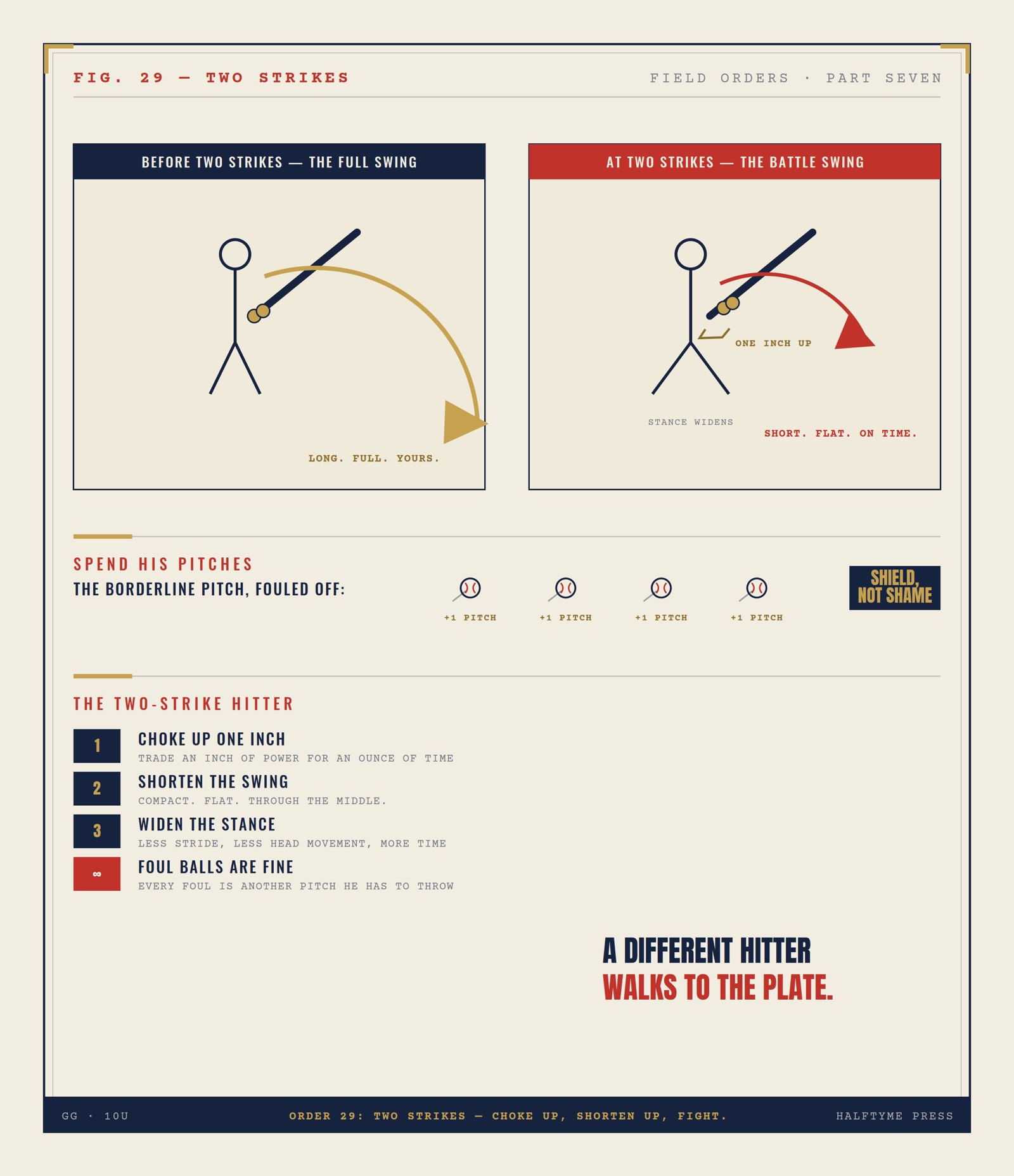
The changes are physical and you make all three at once. Choke up — an inch on the handle buys control and quickness. Shorten the swing — you're not driving the ball anymore, you're beating it to the spot. Widen your zone — Order 26 already told you why: behind in the count, anything close gets defended, because the umpire's opinion of the corner pitch is a risk you can't carry.
And here's the weapon nobody puts on a highlight reel: the foul ball. With two strikes, a foul ball is a shield — the at-bat continues, the pitcher throws again, and every extra pitch is another chance for his mistake. Spoiling tough pitches until he leaves one over the plate isn't failing to hit. It's winning ugly, one pitch at a time.
A long two-strike at-bat wears on a pitcher even when you make an out at the end of it. Eight pitches of fouls and takes is eight pitches he can't throw in the sixth inning. Sometimes your at-bat's real RBI shows up an hour later.
The Two-Strike Hitter
Four Reps — Write It In
Write the three physical changes you make the instant strike two goes up. Hands, swing, zone.
1-2 count, nasty pitch on the outside corner — maybe a strike, maybe not. Why can't you leave that decision to the umpire?
You foul off four straight tough pitches, then he finally floats one over the middle. What did the foul balls actually do? Name it as a weapon.
You battle nine pitches with two strikes and fly out. Your teammate swings at the first pitch and singles. Whose at-bat helped more in the sixth inning — and what did yours take from the pitcher?
The Trap
Pride keeps the big swing alive at 0-2. Choking up feels like admitting something, so kids stand there with their home-run cut and their tiny zone while the pitcher picks at corners. Read the order again: a DIFFERENT hitter walks up with two strikes. It's not the same hitter swinging smaller — it's a new job entirely. The kid who can't change hitters mid-at-bat isn't proud. He's predictable.
This is the page where the mental game and the bat finally shake hands. Two strikes is a pressure test, and the answer to pressure is always the same: smaller task, executed now. Not "don't strike out" — that's a wish. "Choke up, see it, beat it to the spot" — that's a job. Generals under fire don't try harder. They simplify.
Two strikes — bigger zone,
shorter swing, foul it off.
Order 30
Reading the
Defense
The last order in this book asks you to do one thing before you step in the box: look up. Nine players are standing in nine chosen spots, and every choice is a message about you.
Corners pinching in? They're expecting a bunt — which means the ground behind them is open, and a hard chop past a charging third baseman is a double. Outfield playing shallow? They've decided you can't hit it over their heads — so a ball over their heads is extra bases, and even a routine liner drops behind a drawn-in fielder. Second baseman shading toward the bag? They think you pull everything — and right field is standing open, unguarded, like a door someone forgot to lock.
You've spent twenty-nine orders learning why defenses stand where they stand. That knowledge runs in both directions. Every rule in this book, reversed, is a scouting report — you know where they should be, so you know instantly when they're somewhere else, and somewhere else is always an opening.
This is the whole book in one habit. The player who looks up before every pitch — bat in his hands or glove — is playing a different game than the player who doesn't. Slower. Clearer. Already decided. That was always the point.
The Messages
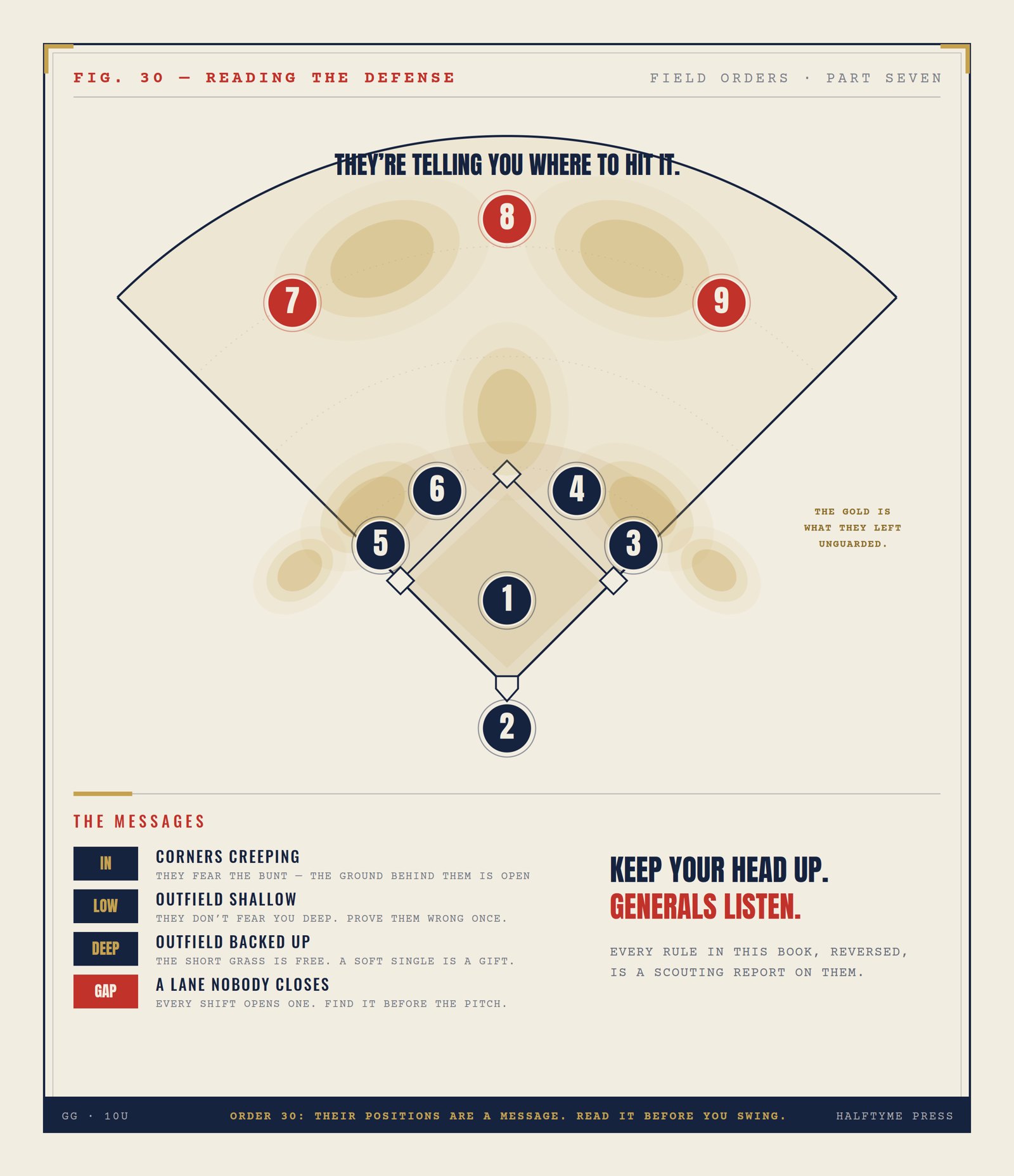
Four Reps — Write It In
You step in and both corners are on the grass, creeping. What do they expect, and where did their positioning just open a door?
The whole outfield is playing you shallow. What are they saying about you — and what's the most expensive way to prove them wrong?
The second baseman is shading way toward second. Which order taught the DEFENSE to shade like that — and what does the empty grass behind him offer you now?
Last rep in the book. Next game, before one at-bat, look up and read all nine. Write the date, the count, and the one message you saw.
The Trap
Reading the defense fails one way: trying to aim mid-swing. The read happens BEFORE you dig in — it picks your plan, maybe your pitch to hunt, and then the swing is just the swing. A hitter steering the ball at contact is a hitter who does nothing well. Look up early, decide once, then trust it. Sound familiar? It's Order 03. It was always Order 03.
Thirty orders, and here's what they were all secretly teaching: baseball is a game of information, and most of it is standing in plain sight, free, before every pitch — for anyone willing to look up. You know the numbers now, the ladders, the strings, the reads. So here's my last order, and it covers everything: keep your head up. The game will tell you what it's about to do. Generals listen.
Look where they're standing. They're
telling you where to hit it.